Showing posts with label sprinkler. Show all posts

Tuesday, September 4, 2018

Prime's Clippings September 2018

Photo of Silver Nightshade courtesy of John Pavelka on Flickr
photo courtesy: John Pavelka
Silver Nightshade, Solanum eleagnifolium
A beautiful late summer 'weed,' blooms even during a drought


Hurry Up Fall- It's Hot!


Although we had a nice big rain event in mid August- and one to start September (woohoo!)- this has been a very hot, dry, challenging summer season for north Texas gardeners. I can’t say enough good things about the rain, let's hope we continue to see more. We have been running a rain deficit all year and have had brutally hot temperatures, setting several new records. Any rain is good rain, and that should ring true for the rest of the year or until we finally get some major moisture.

Up north, fall dependably begins in September when the kids head back to school. Around here, be prepared for another two months of hot weather. We should catch a break in October, but our lawns and plants don’t know that fall officially begins September 22nd. They just know they haven’t had enough to drink all season.

Regardless of the eventual onset of cooler weather, September and October are two very important months for north Texas gardeners.

Probably the most important chore coming up is the application of fall pre-emergent weed preventative to our lawns and beds. Equally important is a fall fertilization with a balanced product including potassium for the roots. Some gardening experts will tell you there is a perfect range of days in which to apply pre-emergent, but in truth that range can be quite extensive, and even applications outside of the peak period can be effective. But if you are a do-it-yourselfer, this is the single most important application you can make. Don’t forget to do it!


Fall veggie gardens can be a bright spot at the end of this tunnel of heat. There are a number of veggies you can plant from seed and transplants over the next few weeks and then enjoy harvesting when our milder weather finally returns. Check out this easy guide from Texas Agricultural Extension Services: http://dallas-tx.tamu.edu/files/2010/06/Vegetable-Planting-Guide.pdf

It is also nearly time to plant shrubs and trees again. So take heart! Next month we will hopefully be talking about fall weather.


Winding Down a Challenging Summer

This was a record year for temperatures and seemingly for chinch bug damage as well. I have never seen so many chinch bug problems. They will remain active as long as it remains hot, so if you see a dead patch starting in your St Augustine check for a sprinkler problem and then treat immediately if chinch are present. I had 4 different patches of chinch bugs in my own yard and have never had them before.

Grub worms can still be treated too and we are starting to see infestations and some damage. Grubs do some of their worst damage in the fall but as soils cool they move deeper into the soil, becoming harder to control. Treat now!

We are still several weeks from lawns starting into dormancy so continue to mow weekly and water regularly. See the tips above regarding fall pre-emergent and fertilizing. You may make applications at any time now.

Avoid trimming spring blooming plants like azaleas and spiraeas any more this year as you may be removing spring blooms. Also avoid high nitrogen fertilizers on spring bloomers, but you can still use balanced fertilizers and especially iron or acidifiers for chlorotic plants.

If we get into a wet spell, watch for lawn diseases like brown patch (later) or gray leaf spot (now), and powdery mildew, fungal leaf spot, and scale insects on shrubs. Treat as needed depending on severity so your lawn and plants go into winter healthy and happy.


Rye and Fescue Seeding

Time for our annual reminder about over-seeding your lawn with ryegrass. There are two types of rye seed available, annual and perennial. Annual rye seed is the one most commonly used but will need to be mowed every week in the spring. Perennial rye is more refined, with a darker green color and slower rate of growth, is more difficult to germinate. In our area the term perennial is not accurate. Most rye burns out by June. In shady areas or if we have prolonged cool, wet weather into the summer, ryegrass may persist longer.

The normal preparation for over seeding is to mow the lawn a few notches lower and remove the clippings during the last half of September through October. This allows the seed to make better contact with the ground and improves germination. The seed should be watered several times a week until it is up and growing. In about two weeks lightly touch up any thin areas. Once it is up, mowing will vary depending on the weather and type of seed used, but once every 2-3 weeks is usually the norm until about March. Light fertilizing in December will enhance the appearance.


Pricing: Scalping, over-seeding, and touch up is based on square footage and will run around 8 times the cost of a normal mow. If your mowing is $35, your annual rye installation will be $280. Perennial rye would be $52.50 additional.

For larger or commercial properties call or email us to request a quote.

Fescue is a northern grass that struggles here in July and August, but there are transitional mixes now that are an option for heavily shaded yards where St Augustine just will not make it. If you have heavy shade and prefer a lawn there instead of groundcovers or a shade garden, then fescue may be a fit for you. Like rye, it will germinate now and establish during the winter and spring months. As mentioned, it thins out in our hottest months and does need regular watering, but simply reseed each fall to thicken it back up. Fescue does not need to be mowed as often as rye.

We have found an excellent way to install fescue is to aerate the area with a core aeration machine and then broadcast the seed. This is especially effective on slopes where seed may wash.

We only recommend fescue for shaded areas where you are having trouble growing St. Augustine. The pricing is based on square footage with a minimum of $250.


Upgrade Your Commercial Facility To A Hydrawise Smart Wi-Fi Irrigation Controller and Save $$$


Wi-Fi based sprinkler controllers have been making headway in the residential market for the past few years. The drawbacks have been dependability and a limited amount of zones that could be utilized, making them unsuitable for our typical commercial properties. Now there are finally some good choices for commercial and larger properties.

What is the Hydrawise Smart Wi-Fi controller? Hydrawise is a new line of controllers by Hunter, a long-time leader in commercial and residential irrigation products. Hunter is the preferred controller for a large segment of contractors, Licensed Irrigation designers, and Landscape Architects due to their dependability, ease of use, and functionality. Approximately 90% of our properties have Hunter controllers. The new Hydrawise controllers are connected to the internet through your Wi-Fi signal and allows you and your contractor/installer to monitor and program your sprinkler system from a home or office computer, laptop, tablet, or phone anywhere that you have internet access. Additionally, it is connected to local airport or independent weather stations giving it both real-time and predictive weather capabilities.

State law currently requires that controllers be equipped with rain and freeze sensors so that they do not run when temperatures are below 40 degrees or there has been a measurable amount of rain. This is of course to reduce water waste and prevent accidents and injuries due to ice forming if it drops below freezing when the sprinklers are going to run. Although this is helpful, using both real weather data from a nearby station and the forecasted temperature and rainfall add another layer of safety and water savings potential, and eliminates the inherent fallibility of sensors. Obviously weather forecasting is also fallible, but you can select a wide parameter of settings for predicted rainfall or temperatures to manage your application.

The controller will also let you set programs based on actual weather data rather than just a time based schedule. Using this function or setting good predictive settings can lower your water usage. And this weather based system provides the best security of not having a sprinkler run before freezing weather comes in, reducing your liability for ice related accidents.

A flow sensor device is another enhancement available for properties with up to a 2 inch mainline. This can be installed into the plumbing and will alert the controller and the users of a potential leak. On older systems that are prone to frequent breaks or valve failures this can pay for itself in just a season or two.

The Hydrawise is suitable for residential as well, capable of working with any system from 1 to 54 zones. For a quote on upgrading your system, email us or call and ask for Mike or John.


September Chores


  • Mow weekly and do not bag clippings
  • Treat fire ants
  • Overseed rye grass
  • Apply weed pre-emergent and fall fertilizer
  • Sow wildflower seeds for spring


John Hoover
General Manager


Our goal is to fulfill the needs of the customer by providing timely, quality services and products.

Thanks for your business!


Monday, July 3, 2017

Prime's Clippings July 2017


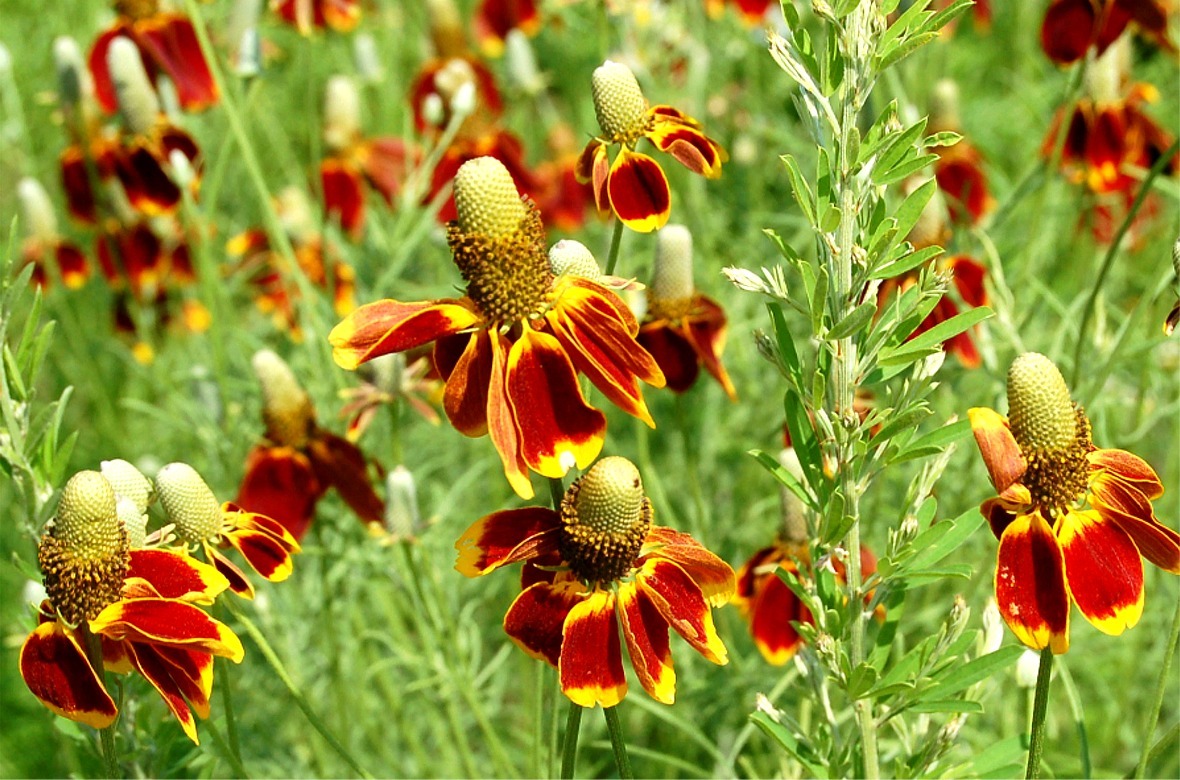
Ratibida Columnaris- Mexican Hat - a prominent summer wildflower


A Nice Start to Summer


We have finally erased the deficit on our annual rainfall total, making up for a dry May with several inches in June. That really helped our soil moisture levels and our lakes are in pretty good shape. Plus we had a bonus on June 24, the fifth day of summer, with a cold front that kept our high temperature under 80 degrees! I’ll give June 2017 an A.

Here’s a fun fact: The high on June 24th was 10 degrees lower than the record high set in the dead of “winter” on Feb. 11 when we hit 88. Okay, I’m wearing everyone out with weather trivia, but this lack of normal patterns plays heck with our gardens. We coupled the warmest winter on record in DFW —great for insect pests, with a couple of 14 degree days in early January that burned crapes and other plants. So what does the rest of summer hold? If the first six months are any clue, who knows?

We can likely count on 2 months of hot, dry weather and a need to supplement Mother Nature’s blessings with regular water from our sprinkler systems. With that in mind, read on for a primer on how your sprinkler system works, and how to get the most out of it.

Horsemint- A wildflower that loves the heat and is great forage for honey bees.


Sprinkler Systems 101
(most likely a lot more than you want to know, but not nearly as much as we could tell you!)


Thanks to Murphy’s Law, it seems that right when you need your sprinkler system the most is also when it is most likely to break down.  Unlike changing the oil in your car, there isn’t a whole lot of preventive maintenance you can perform on your sprinklers, but routine inspections are extremely important.

A typical sprinkler system starts at the backflow device, which is usually in a large box located a few feet from your water meter. There are 2 handles here which are used to turn the water off to the sprinklers without affecting the water to your house.  Silt often accumulates around this valve and the handles corrode, making it difficult to turn off the water in an emergency. We recommend cleaning out the silt once a year and replacing your handles with stainless steel handles. Stainless handles will last forever.

Your control valves are located throughout the yard and have an electric solenoid and rubber diaphragm. These parts fail over time, the wire splices may corrode, and fire ants eat the insulation off the wires. If a valve is not coming on it is often an electrical problem. If it sticks on and runs continuously, it is usually a bad diaphragm or debris may have lodged in the valve. In most cases, we rebuild the valve with all new components, or replace the valve entirely if there is internal wear or other issues. Spray heads are typically used for patterns of 4 ft up to 15 ft, rotors for patterns of 15 ft to 40 ft, drip irrigation for ornamental beds or pots, and bubbler heads for trees, large plants, or large pots. Pop-up sprays and rotors have seals that harden with age and leak or prevent the head from lowering after it pops up. This is the main reason heads get broken by mowers. Properly installed, a head that is working properly cannot be hit by a mower. If you see a lot of water pooling around a head when it is running it may have a bad seal. Spray nozzles also become clogged, and heads settle so that they are crooked, too low, or too high. Drip is notorious for being damaged by digging in beds, and rodents also love to chew on drip. Correcting these issues is all part of routine maintenance. Your controller is the brain of the system, and most of today’s controllers have sophisticated settings that allow you to optimize how and when you apply water. Like any computer, they may be damaged by power surges, lightning, or gremlins. But what is the first thing you always check when your controller isn’t working? The electrical outlet! Plug something else in and make sure you have electricity there. If so, then you can call us to come look for the gremlins.

Sprinkler system scheduling: Okay, this is a subject that can get very involved. There are formulas for calculating how much water you may need using actual rainfall amounts, evapostranspiration rates for your lawn or different types of ornamentals, soil types, slope, micro climates, etc. And the truth is that most sprinkler systems are not perfectly designed. There's lots of really good ones, but an equal number with coverage issues. In fact, most spray zones have an efficiency rating of only 60% and rotor zones 70%.


So, for the average property owner with the average system, here are some easy to follow guidelines:
  • Most weeks in summer we need to apply about 1 inch of water to our yards. 
  • A spray zone applies about 1.5 inches in an hour.
  • A rotor zone applies about .5 inches per hour.
  • A drip zone applies about 1 inch per hour, but drip can vary considerably because there are so many different products and ways to design it.
So, you will need to run your sprays about 40 minutes a week, your rotors for 2 hours, and your drip 1 hour. Maybe a little more according to how efficiently they are working.

For lawns and established shrubs it would be ideal to apply all that water at one time so you get a really deep soaking, encouraging deeper roots. But flowers, new plantings, and some common plants like hydrangeas and caladiums need water more than once a week. For ease of programming, and to cover the variety of plants that you may have, most properties should be set up to water two to three times per week.

So now we have a  twice a week schedule that looks like this:
  • Spray zones 20 minutes, Rotor zones 60 minutes, Drip zones 30 minutes

And here is the last tweak that is not difficult and will really help you get the most out of your water. Except for some lucky folks (like me) that live in a narrow sandy band of the Cross Timbers that runs through north Texas, most of us have clay or clay-loam soils. These soils are tight and accept water very slowly. That means that your water will start running off after just a few minutes of watering. How to solve this problem? Set your sprinklers to run twice in one cycle, using half the water each time. Some controllers have a built in Cycle/Soak function that you can program, but all controllers have the ability to let you set two or more start times. That is a really simple way to get more water to soak in.

Lets say you have 4 spray zones, 2 rotor zones, and 1 drip zone.
What is the total run time needed?
  • 4 zones x 20 minutes = 80 minutes, 2 ones x 60 minutes = 120 minutes, and 1 zone x 30 minutes for a total of 230 minutes or about 4 hours.
  • Set your sprays for 10 minutes, your rotors for 30 minutes, and drip for 15 .
  • Set your first start time for 12:00 AM, then set a second start time for 4:00 AM
That gives your first cycle a chance to soak in and you will have less water running down the gutter! This also works well for watering on slopes.

Again, these are basic guidelines. You may have shady areas that need less than hot sunny areas so adjust those times down. Or a big bed of begonias that may struggle with watering just twice a week in the heat of summer, so you could add a “B” program for an extra day to water just that zone.

As I said at the beginning, this can get very involved. You can follow these guidelines, or consult with us further if you really want to see how much you can do to keep more of your water going where you want it—the roots of your plants.

You are welcome to email questions to me at:
John@primelandscapeservices.com
Texas Licensed Irrigator #0004812


The Big Email Push

Experts agree, e-mail is the only way to go!

Once again, we are reminding everyone to sign up to “Go Green” and start receiveing your invoices and newsletter via e-mail. We do not share your address with anyone, and we do not send out e-mail blasts soliciting your business.

You can also pay with your favorite credit card if you prefer.

Just call Olivia at 817-461-4000 to set it up.

Better yet, send an e-mail to: contactus@primelandscapeservices.com

Thanks!


July Chores


  • Mow Weekly
  • Finish planting summer flowers
  • Mulch beds
  • Treat new fire ant mounds after rains
  • Watch for chinch bugs in the lawn
  • Treat for grub worms
  • Check sprinklers


Our goal is to fulfill the needs of the customer by providing timely, quality services and products.
Thanks for your business!


John Hoover, General Manager

Friday, July 8, 2016

Prime's Clippings July 2016

Happy 4th of July!


Celebrate Summer

We haven't hit the century mark yet and the floods have helped get our soil moisture and lakes recharged. But rains have been really sporadic now for a few weeks and you need to run and manage your sprinklers wisely from here on out. You can keep most of your landscape looking good with twice a week watering, but it takes a well tuned sprinkler system, a well designed program, and due diligence to make sure everything is working properly. Newly planted shrubs and trees need a deep soaking weekly and some flowers will need water more than twice a week. Remember, a water hose can be your best friend in July and August. It’s relaxing and the best way to assure new plants get what they need. 


Summer Lawn Pests and a Special Offer

With hot dry weather here, conditions are optimum for chinch bugs. Chinch bugs are often the cause of large dry looking areas in sunny St. Augustine lawns, and may also attack Bermuda. If you notice a possible infestation call us immediately! Most of our lawn application programs are set up for every 5-6 weeks, and if chinch bugs start feeding after we have recently been on your property there could be serious damage before we are out for the next application.

Gray leaf spot is a fungal disease that primarily affects St. Augustine in warm humid weather. The result is mottled yellow areas that are most noticeable after fertilizing. The fertilizer will green up unaffected areas making the infected areas paler in comparison. Severe cases should be treated with fungicide.

The grub worm is another nasty pest. It is much more difficult to determine whether or not you will have a problem with grubs because they feed on root systems in the soil, and usually by the time you see the grass turning brown the damage has already been done. The best time to apply chemical control for grubs in our area is from mid July through August.

If you’re already on our chemical program, give us a call during the first two weeks in July and we will include an insecticide treatment for Grub Worms AND Chinch Bugs for just $24.95 when we’re out to do your next regular lawn application (price good for lawns up to 5,000 sq. ft.)


John and Team Install New Landscape at Six Flags

We were honored to be selected for landscaping the newest addition at Six Flags comprised of 3 rides in the Gotham City section. Due to the narrow time frame and constant rainy conditions it was quite a challenge but we were able to beat the deadline. The highlights of the job included a large grove of 14 foot tall Muskogee crape myrtles that will bloom in lavender that matches the color scheme of the rides, and our design of the pedestals for the Catwoman Whip ride. John located gray and charcoal shades of stone to make the perfect match for the dark atmosphere of Gotham City. Pancho and crew executed it beautifully. Be sure and check it out on your next visit, and ride the Riddler Revenge!


Monday, February 29, 2016

Prime's Clippings March 2016

A Record Warm Winter Creates Spring Challenges 

Last month I said I wouldn’t start planting begonias just yet in spite of the spring-like temperatures, but this has certainly been the warmest winter in many years. We could have planted lots of warm weather plants in February but the likelihood of a March freeze still holds true for another 20 days, so let’s try to be a little patient!

The recent rain was sorely needed, but weeds are now exploding onto the scene. Pre-emergent applications from the fall were only partially effective after being diluted with nearly 20 inches of rain in October – November. We are applying broadleaf control for plants like dandelion and henbit now and spot spraying for certain grassy weeds like wild rye. Remember though that most of these plants have begun flowering already and it takes at least 2 weeks and 2 applications to knock these weeds down. Our crews are busy cutting back roses, perennials, and grasses, and I hate to tell you but it is already time to fire up the mowers.

So here is our annual reminder: RESIDENTIAL CUSTOMERS! If you are not on a year-round contract, please call to let us know when you are ready for mowing or your spring clean up.  We don’t want you to wonder where we are, but we also have some clients that like to wait until late in March to start.

And not to be the bearer of bad news, but with less than half of our normal freeze days this winter we can probably expect lots of insect issues and an early crop of mosquitoes and fire ant activity. We will try to keep you informed as we observe these problems, but let us know if you need our help. We offer mosquito fogging, fire ant control that is guaranteed all season, and treatments for other pests we will see this year, such as bagworms, tent caterpillars, and chinch bugs.

Ready or not, we are into an early spring so hang on for the ride!


No Fire Ants For The Season - Guaranteed! 

Fire ants may be the most annoying pest of all. They do millions of dollars in damage each year to electrical equipment and agriculture, and swarm out when disturbed to inflict painful bites to children, pets, and any unsuspecting gardener.

Fire ants can migrate miles when swarming and tunnel up to 20 feet deep, so permanent eradication is not possible. However, we can treat your entire property with a long residual product that will eliminate existing colonies and create a barrier to prevent new swarms from moving in. When done in March, we guarantee control for 8 months!

Prices start at just $155 for a full year. Call for your free quote today and get 10% off your first year!


Pond Season Starting Up 

String algae season is starting early this year. As much as we love our beautiful water features, we pond owners hate string algae equally. Since aquatic plants have not come out of dormancy and cool water temperatures reduce the bacteria colonies in your filters and gravel, conditions are optimal for the growth of string algae. Algae is a natural, healthy organism in any natural water feature, but it can bloom suddenly in a matter of days and become unsightly.

We start our annual clean outs this month, changing the water, washing down the gravel, removing the sludge, cleaning the filters, trimming and thinning out water plants, and changing the water to get your pond started on the right foot for spring.

Give Spencer a call to book your spot for your spring clean out!


Thank You For Your Business

Spring is upon us in full force. We want to thank all our clients who started on their spring projects with us a month or two ago when we had a little more free time, and we appreciate the patience of all of you who are now calling in for landscape projects and having to wait for your estimate. We will do our best to get to whatever you need as quickly as we can.

We look forward to working with you in the coming season. And remember- email is a great way to communicate with us!

contactus@primelandscapeservices.com 


Thursday, July 2, 2015

Things You Should Know About Your Sprinkler System

Thanks to Murphy’s Law, it seems that right when you need your sprinkler system the most is also when it is most likely to break down. Understanding the basics of how your sprinklers work can help you use them more efficiently and know how to spot potential problems. Unlike changing the oil in your car’, there isn’t a whole lot of preventive maintenance you can perform on your sprinklers. However, routine inspections are extremely important.

A typical sprinkler system starts at the backflow device, which is usually in a large box located a few feet from your water meter. There are 2 handles here which are used to turn the water off to the sprinklers without affecting the water to your house. Silt often accumulates around this valve and the handles corrode, making it difficult to turn off the water in an emergency. We recommend cleaning out the silt once a year and replacing your handles with stainless steel handles. Stainless handles will last forever.
Your control valves are located throughout the yard  and have an electric solenoid and rubber diaphragm. These parts fail over time, the wire splices may corrode, and fire ants eat the insulation off the wires. If a valve is not coming on it is often an electrical problem. If it sticks on and runs continuously, it is usually a bad diaphragm or debris may have lodged in the valve. In most cases, we rebuild the valve with all new components, or replace the valve entirely if there is internal wear or other issues.

We typically use spray heads for patterns of 4 ft up to 15 ft, rotors for patterns of 15 ft to 40 ft, drip irrigation for ornamental beds or pots, and bubbler heads for trees, large plants, or large pots. Pop-up sprays and rotors have seals that harden with age and leak or prevent the head from lowering after it pops up. This is the main reason heads get broken by mowers. Properly installed, a head that is working properly cannot be hit by a mower.  If you see a lot of water pooling around a head when it is running it  may have a bad seal. Spray nozzles also become clogged, and heads settle so that they are crooked, too low, or too high. Drip is notorious for being damaged by digging in beds, and rodents also love to chew on drip. Correcting these issues is all part of routine maintenance. 

Your controller is the the brain of the system, and most of today’s controllers have sophisticated settings that allow you to optimize how and when you apply water. Like any computer, they may be damaged by power surges, lightning, or gremlins. But what is the first thing you always check when your controller isn’t working? The electrical outlet! Plug something else in and make sure you have electricity there. If so, then you can call us to come look for the gremlins.