Friday, January 15, 2016

Prime's Clippings January 2016

Hello 2016!

Daffodils- Coming soon to a yard near you!

We hope everyone enjoyed the end of year festivities and the pleasant  Christmas weather- no floods!

We are always excited about the possibilities a new year brings, and anxious to see what roller coaster weather events come with it. So far so good, but we’ve got a long ways to go.

Our winter plans will find us working hard on our operations so that we can provide you the best possible services in 2016. We value your feedback, so please help us to serve you better by letting us know what you need.

And this is the time of year when good gardeners make their plans and start their home improvement  projects for the New Year.

So take this time to reflect on last year’s successes and make your plans for an exciting 2016.


Our Annual Mulch Special is Here

Mulching your beds is absolutely the best thing you can do for the health of your soil and plants.

Remember: mulch reduces weeds, improves soil structure, conserves moisture, protects plants from extreme cold and summer heat, and gives your beds a neat appearance.

Take advantage now! Mention our newsletter for 20% off normal prices.

Prices Include Delivery and Installation!
(extra charges may apply for weeding or leaf clean ups if needed)

How much do I need? We recommend adding 2” to existing mulch or 3” to unmulched areas. A 2 cu. ft. bag will cover about 10 sq. ft. 2” deep or 7 sq. ft. 3” deep


DISCOUNTED PRICE

Hardwood: $5.00 per 2 cu ft bag
Dark brown, enriches soil as it decomposes

Cedar: $5.85 per 2 cu ft bag
Great cedar smell, lighter color, lasts longer

Red or Black Mulch: $5.60 per bag
For a decorative look


January Happenings

Remember that we do clean gutters!
Leaves: Most of our leaves are down and we should finish the last of our leaf clean ups in early January. Some trees like Shumard oak are still holding their leaves but should finish dropping any day now. Live oaks drop in Feb - March, giving us another round of  leaf clean-ups in late winter. If we haven’t gotten to yours and at any time this winter you need a clean up please call to let us know.

Weeds: Our first round of Spring pre-emergent weed control will start in January-February. This application and the next one in March also contain a broadleaf weed killer for any dandelions, henbit, or chickweed that may have come up over the last few months. Even when they are caught early it still takes two applications to kill them. With a wet winter so far and more rain predicted it may be a banner year for weeds. Please note that grassy winter weeds like wild rye and rescue grass are very difficult to control. They require spot treatments with specialty herbicides which take several weeks to work.

Pruning: Most perennials are dormant now and need to be cut back. Ornamental fountain grasses like Maiden and Muhly grasses look nice for awhile after dormancy but will start to shed and get messy. We will start cutting those back in January as well. Roses should be cut back in February. Winter is also the time to make drastic cuts if you are trying to reduce the size of overgrown shrubs.                                          

Groundcovers: Our liriope and Asian jasmine groundcovers should be cut back before they start to put out new growth in spring, and with our unpredictable winters it is hard to pick the best time. We normally wait until the end of January to avoid exposing them to temperatures in the teens.

Transplanting: January is a good month for transplanting shrubs and dividing most perennials.

Tree Trimming: Limb structure is easiest to see when trees are dormant, so now would be the time to clean up your trees. Remember in Arlington that tree limbs by city code must be kept 14 ft above the street. This is a good idea regardless of where you live, so your limbs are not damaged by delivery trucks and they do not impede emergency vehicles like fire trucks.

Planting: Our constant reminder! Fall and winter are our best seasons for planting new shrubs and trees to avoid moisture stress and get the root systems established before summer!


Got Ice? We Can Help.

Don’t let a winter storm shut your business down or create a hazardous situation for people trying to access your home or business!

We aid several of our commercial properties with snow and ice removal, salting, and sanding. We are ready again should the need arise, and can even help homeowners with ice melt for steep driveways and sidewalks.

Please call us ahead of time and let us know if you would like de-icing or snow removal services for your home or business before the next big storm.


A Word About Crape Myrtle Trimming

Crape myrtles are traditionally pruned in January. The horticulturally correct method is to treat a standard tree-form crape like any other tree. Prune entire branches to allow more sunlight into the canopy and reduce overcrowding, remove low branches that are in the way, remove water sprouts and suckers, and strip the seed pods if their appearance bothers you or cut tips of limbs no larger than a pencil. 

However, many properties and some homeowners want their crapes kept within a certain size range and this limit requires “topping” or more drastic cutting of the crowns. Since we have to administer both techniques, be sure to let us know if you have a preference.


Thursday, July 2, 2015

Things You Should Know About Your Sprinkler System

Thanks to Murphy’s Law, it seems that right when you need your sprinkler system the most is also when it is most likely to break down. Understanding the basics of how your sprinklers work can help you use them more efficiently and know how to spot potential problems. Unlike changing the oil in your car’, there isn’t a whole lot of preventive maintenance you can perform on your sprinklers. However, routine inspections are extremely important.

A typical sprinkler system starts at the backflow device, which is usually in a large box located a few feet from your water meter. There are 2 handles here which are used to turn the water off to the sprinklers without affecting the water to your house. Silt often accumulates around this valve and the handles corrode, making it difficult to turn off the water in an emergency. We recommend cleaning out the silt once a year and replacing your handles with stainless steel handles. Stainless handles will last forever.
Your control valves are located throughout the yard  and have an electric solenoid and rubber diaphragm. These parts fail over time, the wire splices may corrode, and fire ants eat the insulation off the wires. If a valve is not coming on it is often an electrical problem. If it sticks on and runs continuously, it is usually a bad diaphragm or debris may have lodged in the valve. In most cases, we rebuild the valve with all new components, or replace the valve entirely if there is internal wear or other issues.

We typically use spray heads for patterns of 4 ft up to 15 ft, rotors for patterns of 15 ft to 40 ft, drip irrigation for ornamental beds or pots, and bubbler heads for trees, large plants, or large pots. Pop-up sprays and rotors have seals that harden with age and leak or prevent the head from lowering after it pops up. This is the main reason heads get broken by mowers. Properly installed, a head that is working properly cannot be hit by a mower.  If you see a lot of water pooling around a head when it is running it  may have a bad seal. Spray nozzles also become clogged, and heads settle so that they are crooked, too low, or too high. Drip is notorious for being damaged by digging in beds, and rodents also love to chew on drip. Correcting these issues is all part of routine maintenance. 

Your controller is the the brain of the system, and most of today’s controllers have sophisticated settings that allow you to optimize how and when you apply water. Like any computer, they may be damaged by power surges, lightning, or gremlins. But what is the first thing you always check when your controller isn’t working? The electrical outlet! Plug something else in and make sure you have electricity there. If so, then you can call us to come look for the gremlins. 


Wednesday, December 3, 2014

Winter Interest in the Garden

Some of us truly love winter, especially the mild type that we usually see here in North Texas. We have ample opportunities to enjoy our outdoor spaces, but with the dormant season it can be challenging to maintain attractive, interesting settings.


Nandina Domestica
Hollies and nandinas are often taken for granted, but in winter they can be big players with glossy green or red foliage and red berries, and of course they are a summer landscape staple as well. Several shrubs will bloom during the winter months. Include a few quince, camellia, mahonia, and winter flowering honeysuckle for periodic flowers. Certainly pansies and violas are the stars of winter, and an over-seeded lawn of lush rye grass really sets off flowers and shrubs.
A water feature such as a fountain or waterfall entices the senses year- round, and brings a special excitement during hard freezes when impromptu ice sculptures form.

The outdoor living craze has brought the element of fire back into the landscape in a variety of forms, from fireplaces to fire pits to chimineas. Now is the time to really make use of these accessories.

Cedar Wax Wing
And don’t forget to hang a few bird feeders for a stream of colorful, busy visitors all winter. 

So, there you are, on a brisk clear winter day, sitting next to your roaring fire pit, enjoying the splash of your fountain and your colorful flowers, watching the cedar waxwings clean the berries off you mahonia bushes.

Fill your yard and your life with interest!    


Thursday, October 9, 2014

A Backyard Paradise

We love it when a plan comes together...

Here we have a gorgeous back yard living area and pool complete with waterfall AND water slide!

Eat your heart out, water parks!


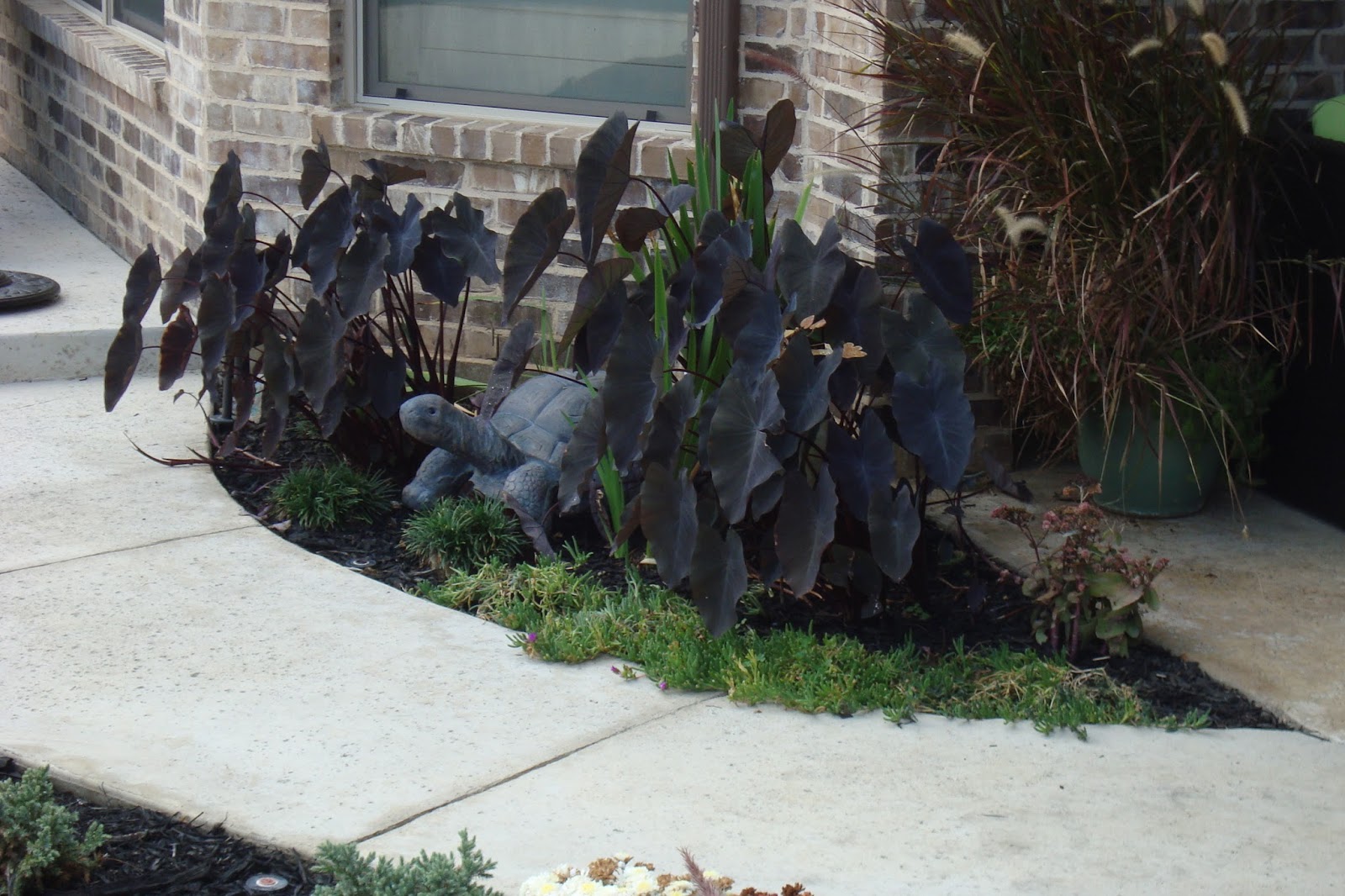
See the turtle of enormous girth, on his shell he holds the earth;
his thought is slow but always kind, he holds us all within his mind

Fall Lawn Treatments- The Most Important Application of the Year

It's not too late to schedule the most important lawn application of the year!

If you are on our regular lawn application program you will be receiving an application of pre-emergent weed control in September-October.

This is the most important lawn application of the year! Winter weeds begin germinating in September and October, and depending on weather conditions may not be noticeable until spring. But if you want the best chance of reducing or eliminating those unsightly weeds you see in March, you must treat the seeds now!

Dandelions, thistles, henbit, chickweed, oxalis, rescue grass, and poa annua are the biggest culprits in our spring gallery of weed problems, and most of these seeds will start sprouting when soil temperatures at the surface drop below 70 degrees. It doesn’t take too many days of cool cloudy weather to achieve this, so timing is critical.

Pre-emergents never provide 100% control, but they will make a big difference. Pre-emergents work by creating a chemical barrier in the soil that kills the seedling as it starts to emerge. This application may be combined with a broadleaf weed post emergent control to kill any that have already sprouted. Heavy rains or wet winters may dilute or move the chemical barrier deeper in the soil sometimes reducing effectiveness.
Don't let those pesky weeds get the drop on you!

Our Fall application also includes fertilizers to get your lawn ready for dormancy. Nitrogen helps thicken the lawn and smother weeds, and potassium builds stronger root systems to help your lawn through hard freezes and promote early green-up in spring.

Call us today if you would like to schedule a fall application for your lawn. (817)461-4000

Friday, November 1, 2013

Fall Water Garden Services

Leaves are dropping regularly and are probably the biggest challenge in maintaining a naturalistic water feature. It is important to empty the skimmers and keep the leaves scooped out regularly. Clogged skimmers cause a myriad of problems, cutting off flow to the pump, and causing fill valves to run excessively since the water level drops in the skimmer.

Since water plants are starting to go dormant, one solution for shaded ponds is to cover the pond with a leaf net using tubing to suspend the net off the water. We can custom fit a leaf net system to virtually any pond.

Call for more details.

Don't let leaves muck up your water feature!


Time to Order Bulbs

If you want a beautiful spring show of annual tulips, daffodils, paper whites, or jonquils, now is the time to order them! Bulb prices start as low as $.75 each installed with a minimum of 100 bulbs.

We will be picking up our bulb orders this month and start planting after Thanksgiving. Call to place your order today!

Not sure what to plant? Email us!

Beautiful tulips in bloom